ADAPTIVE RE-USE
Adaptive reuse refers to the idea of using an existing structure, object or space and repurposing it into something else. This concept has become immensely important now, as our physical resources are diminishing. With this situation, reusing abandoned architecture becomes important as it can prevent huge amounts of infrastructure being wasted away, which can easily be made into make-shift spaces to respond to the site context.
This re-use, re-invigorate and re-presentation of unused spaces in a city, also generates opportunities for artists, creatives and the community who can fill the space with vibrant installations and activities, also telling the story of the community.
These are short term solutions with long term effects, since, once the community is successfully involved, the functions can adapted to their requirements and interests, keeping the space alive longer than a building with a specific function. This approach could lead to conservation of resources, such as land and increase the overall involvement of the community.

LOW COST HOUSING
Providing low cost housing on site to house marginal workers of the area, since, Rajouri is a heavily commercial cum residential area, without adequate availability of such housing opportunities.
The idea is to recreate the rural community lifestyle using informal collection spaces, courtyards and common terraces. Terraces also aim to provide sustainability to families with possibility of urban farming.
Housing scheme would be porous to provide visual connection throughout the site, while also keeping privacy and security as guiding factors. With families as the ideal audience, units would be incremental with enough common spaces, along with semi-open areas.
Provision of daycare, skill development and urban farming would also benefit the residents with employment opportunities. The public spaces would also provide interaction opportunities between different user groups which would further help lessen the social segregation.

STUDENT HOSTEL
Adding hostel facilities for students due to lack of such infrastructure within the colleges present adjacent to the site. This is to help students in optimizing their time by reducing travel time and avoiding high rent prices. While still being able to access all college facilities and additional facilities provided on site such a library, recreational areas and common rooms.
The idea is to broaden the learning opportunities with a socially mixed and culturally rich environment with people from different social and financial backgrounds coming together, creating a stimulating environment for the students and presenting them with opportunities to do more for the community by getting involved with NGOs present on site and organizing awareness campaigns for the night shelter.
Students can also be involved in the activities of daycare and skill development by volunteering and explore methods of urban farming and localized sustainability, creating a social impact. Ideally, this would lead to a brighter future with more compassionate and empathetic youth.

TERRACES
Multi-level terraces form community spaces for various social groups. They also provide visual connect to the site from all levels.
The green of the terraces add to the sustainability aspect of the design while also reducing temperatures and providing positive stimulus to the residences. These can also be used for farming.


NIGHT SHELTER
Creating a night shelter which proves more than just a roof over the heads of the homeless but also gives them tools to pave their way towards being self sustainable.
Forming community areas and courtyards, resembling the traditional Indian architecture along with urban farming, giving employment opportunities to the people. Also including spaces like daycare and skill development centers on site to help uplift them financially.
The rentable gardens and farms also provide additional employment opportunities, where the produce can be stored and sold directly on site, reducing the cost of transportation and storage. The idea of fresh produce would also attract the residents around the site, forming public spaces leading to interaction and empathy. This also ensures localized sustainability, reducing the overall pollution of the area.
One of the most important aspects of the shelter would be the target audience which would be restricted to women and children to ensure their safety.

PUBLIC COMMERCIAL
Most of the ground floor would be dedicated to public spaces for all user groups, creating an opportunity for different social groups to come together.
Aim is to maintain a visual connect throughout the site without invasion of privacy, while also keeping walkability and usability as guiding factors.
Most of the commercial would be concentrated to one part to avoid excessive chaos throughout the site and minimize the traffic with a dedicated entry point. The connecting road would also act as a mixed use platform with pathways, vehicular road, commercial massing and green belt. The roadway would also lead to the donation area of the night shelter and the urban farming spaces, along with eco-parking. All functions would have dedicated entry points but would be connected to provide ease of access.
FARMING
Converting terraces into organic farms for soilless farming using Hydroponic Farming technique, which uses less space and resources.
Water required by the irrigation system is significantly lesser than conventional farming practices and this would further create employment opportunities for residents while optimizing their built environment.

PATHWAYS
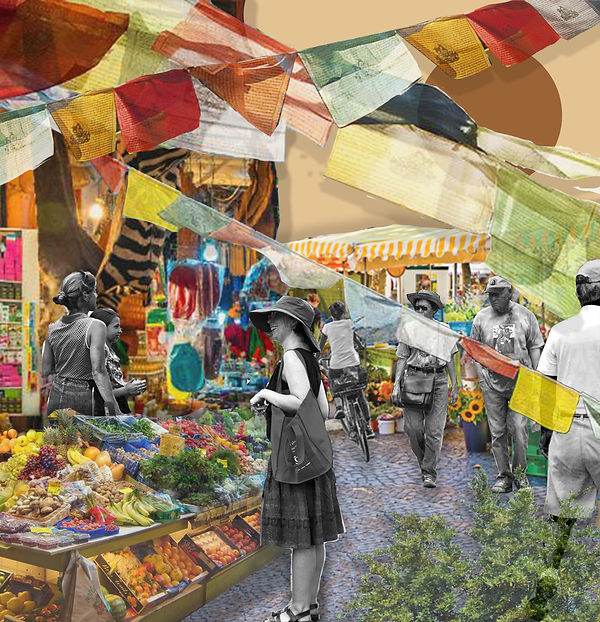
Shaded pathways along the site encourage walkability and are used to guide the user through the site and its functions. They also provide a different spatial environment with informal temporary stalls and colorful banners.
The slits in the walkway also enhance the experience by providing different lighting patterns on the ground throughout the day.